José Luis Pamplona Stoever

Open for work

José Luis Pamplona Stoever

Senior Elixir backend engineer

Business logic, designed and built: every rule written, tested and understood by the team.

  • Elixir since 2017
  • Industrial software
  • Phoenix · LiveView · PostgreSQL · Docker · Bash
  • Querétaro, Mexico
  • Remote, hybrid or on-site
  • Spanish · English C1 (EF SET)

Projects

DEW · Dockerized Elixir Workbench

In development MIT License v0.19.5

GitHub Demo

A workbench for creating Phoenix projects and running them on localhost with nothing installed but Docker, and a knowledge base of the Elixir ecosystem kept as cartridges.

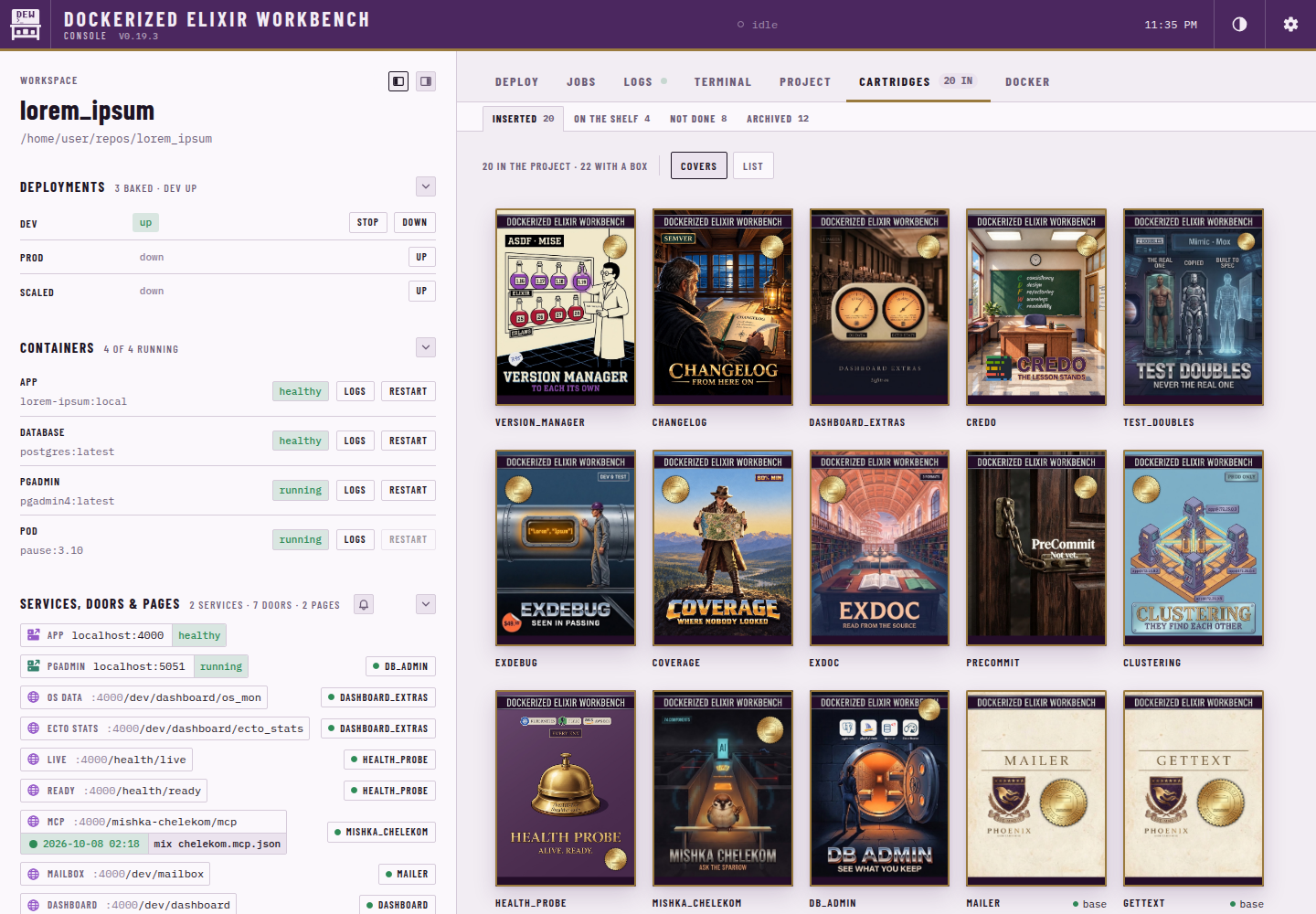
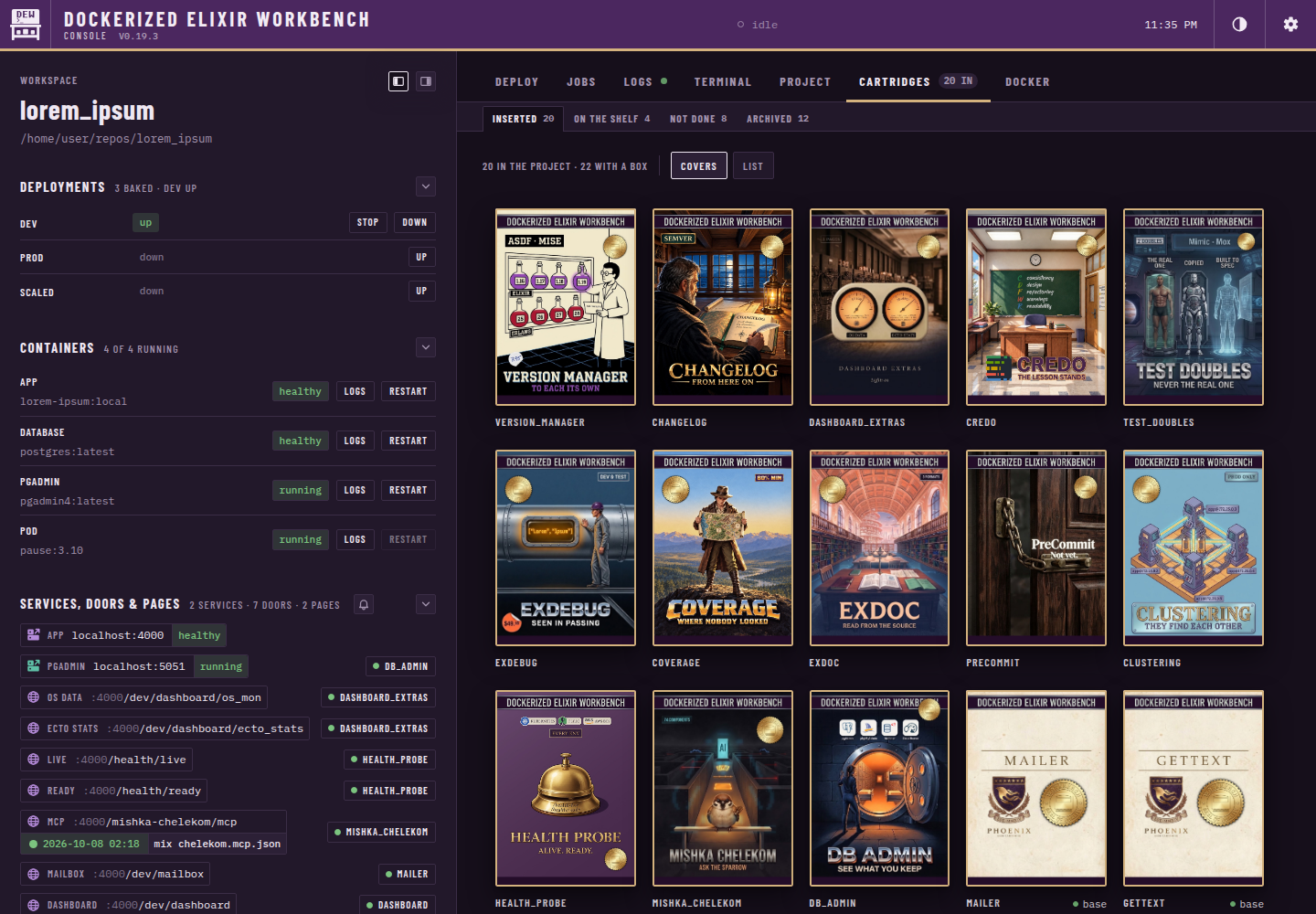
DEW's console with a project up: on the left the workspace, its deployments, containers and services; on the right, the covers of the cartridges inserted in the project DEW's console with a project up: on the left the workspace, its deployments, containers and services; on the right, the covers of the cartridges inserted in the project

The console, with a project up Full size Full size

Some decisions, and what each one cost

1Knowledge lives in the cartridges

Every feature added to a project is a cartridge with its papers: what it installs, the need it answers and why it is built that way, with its sources. The cartridge gives that knowledge a shape: a piece with a name and a cover that what was learned gets attached to, which makes a solution easier to understand, to remember and to keep on record. It is DEW's greatest value.

Cost. Writing a cartridge takes advanced Elixir, and today having cartridges of your own means forking DEW. What comes next is a public collection of cartridges, outside the repository.

How a cartridge is written

2Only Docker on the host

Every mix and git step runs in a container, and the console gathers the workflow that used to live on the host: the server, the logs, the terminal, the tests. What the project needs around it, such as the database, its admin tool or the monitoring, also arrives in containers: nothing is installed or configured on the machine. Work is the same on any computer: having Docker and cloning the project is enough.

Cost. The whole command line is a bash script of about 3,500 lines. It is the price of the host needing only Docker and a shell.

The workbench and its workspace

3The options of phx.new are cartridges too

In Phoenix, the database, the HTML or the mailer are chosen only once, when the project is created. In DEW each one is a cartridge like the rest: it can be added later, and other cartridges can depend on it, like the database admin, which requires ecto.

To make that possible, each of these cartridges generates the project twice, with and without its option, at the Phoenix version the project was born with, and merges only the difference into the project as it stands today. The test: a project born with nothing and grown cartridge by cartridge has to end up equal, file by file, to one born with everything.

Cost. The project has to keep which version of the Phoenix installer it was born with, and DEW has to be able to run that same version again.

The design paper

4The project owes DEW nothing

No route, file or marker exists in a project only for DEW to read. A project becomes independent of DEW at any time: it is enough to stop using wb.sh.

Cost. Since the project keeps nothing for DEW, DEW has to work out its state every time, by reading the code, Docker and git.

Why it is shaped like this

5The project stays as Phoenix generated it

A new Phoenix project looks for its database on localhost, and inside Docker that normally stops working. In DEW, the application and its services share one internal network (a pod), so localhost stays valid and the configuration is left untouched.

Cost. In development, the application has to listen on 0.0.0.0: it is the only line of configuration DEW changes. And the pod takes no replicas, because they would share one address: the scaled deployment runs like production, on a bridge network, with its environment variables set in the Docker Compose file.

Why it is shaped like this

The architecture and every decision are the author's, and are argued in the CHANGELOG. The implementation was AI-assisted.

ExDebug · debugging in Elixir

Published MIT License v1.0.0

GitHub hex.pm Docs 1,844 downloads

A debugging library for Elixir: it chains at any point of a pipeline and prints the value passing through to the console, framed, with its label and colors by data type, without changing the result. It acts only in development and test; in production it lets the data through.

Available as a cartridge in DEW.

Experience

  1. 2026 – present

    DEW · own project, open source

    Full-time design and development of DEW, the workbench.

  2. 2024 – 2026

    Cordage · quality management system (QMS)

    QA Engineer

    I returned to the product whose design I led at iCorp, this time to assure its quality: the QA framework, automated tests with Playwright and technical guidance on Elixir for the team.

  3. 2022 – 2023

    Valiot · AI software for manufacturing plants

    Back-end / CI-CD

    A local end-to-end environment in Docker, where several teams designed each client's data structure and put it to the test before implementing it; continuous integration on GitHub Actions; back-end in Elixir.

  4. 2019 – 2022

    iCorp · from qDoc to Cordage

    Tech lead

    I led the design and development of Cordage, the successor to qDoc: the model with DDD and the back-end with TDD in Elixir. I created and taught an intensive Elixir training program through which recently graduated developers joined the team. What iCorp published about the project

  5. 2018 – 2019

    NUU Group

    Tech lead

    NUU Group and GRVTY Labs merged to offer software development alongside marketing and design, and I stayed with the same team, now as tech lead. Agile frameworks, architecture manuals for the team and back-end in Elixir.

  6. 2017 – 2018

    GRVTY Labs

    Back-end in Elixir

    Back-end of projects for the agency's clients, NUU Group among them.

Education

  1. 2020

    Certified Scrum Developer® · Scrum Alliance

  2. 2011 – 2016

    Software Engineering · Universidad Autónoma de Querétaro

  3. 2006 – 2009

    Computer Technician · CBTIS 118

Download CV (PDF)

Contact

© 2026 José Luis Pamplona Stoever · Querétaro, Mexico